Wholesale vs. Custom: Which Retail Display Strategy is Right for Your Chain Stores?
- Share
- Issue Time
- Jun 2,2026
Summary
This comprehensive ROI-driven article compares wholesale and custom retail display strategies for chain store decision-makers, analyzes their advantages, limitations, hidden costs and real-world scenarios, reveals that custom displays can boost conversion rates by 20-100% and deliver better long-term returns, concludes that a hybrid strategy offers the optimal balance for most businesses, and introduces VIGO DISPLAY's one-stop display solutions and professional consulting services.
Introduction
For chain store operators, brand owners, and retail decision-makers, choosing the right retail display strategy is not just about aesthetics — it directly impacts sales performance, operational efficiency, and brand consistency. According to a 2026 Global Retail Design Report, 68% of purchasing decisions are made in-store, and effective displays can increase category sales by an average of 25%.
This article will give you a complete, practical, and ROI-driven comparison between wholesale and custom retail display solutions, including real-world case studies, hidden cost breakdowns, and actionable implementation guides. We will help you make the right decision that aligns with your business stage, budget, and growth goals.
Understanding Retail Display Strategy for Chain Stores
Before comparing wholesale and custom displays, it's important to understand one key fact:
👉 Retail display is not just about holding products — it's a silent salesperson.
For chain stores with multiple locations, displays must achieve four non-negotiable objectives simultaneously:
• Consistent brand image: Every customer should have the same brand experience whether they visit your store in New York, London, or Shanghai.
• Scalable deployment: Your display solution must be easy to replicate across 10, 100, or 1,000 stores without compromising quality or increasing costs exponentially.
• Cost efficiency: Displays should deliver measurable returns, not just be an expense. Every dollar spent on displays should contribute to higher sales or lower operational costs.
• Sales optimization: Displays should guide customers through the store, highlight high-margin products, and encourage impulse purchases.
This is why choosing the right strategy is one of the most critical decisions you will make for your retail business.
What Are Wholesale Retail Displays?
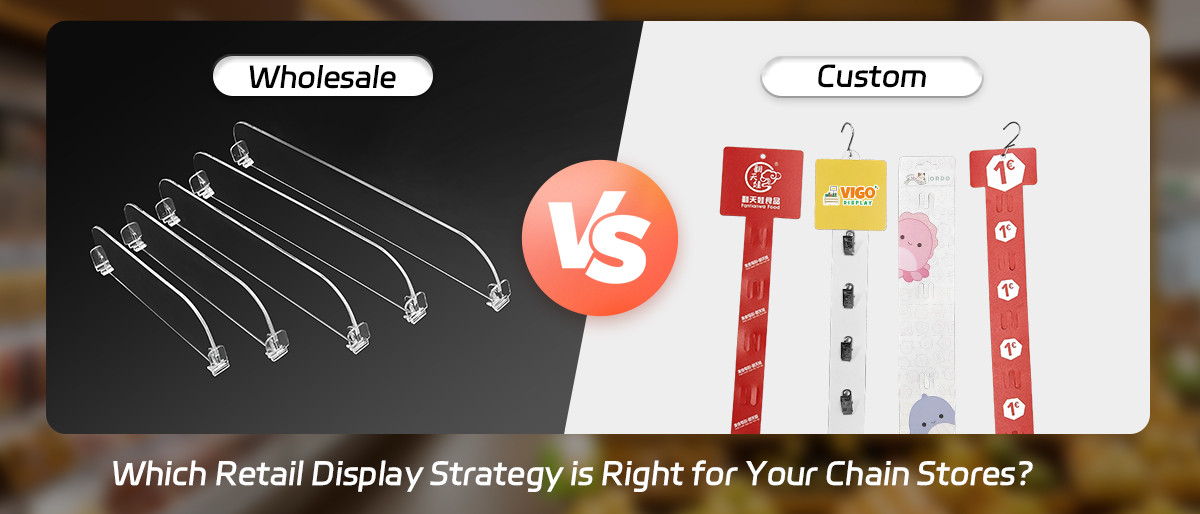
Wholesale retail displays are mass-produced, standardized display fixtures that are manufactured in large quantities and sold to multiple retailers. They are typically available in standard sizes, materials, and colors, and can be purchased in bulk at lower prices.
Common examples of wholesale displays include:
Advantages of Wholesale Displays
1️⃣Lower Cost per Unit
Wholesale displays are 30-50% cheaper than custom displays on a per-unit basis. This makes them ideal for large-scale store rollouts where you need to furnish multiple stores quickly and affordably.
2️⃣ Fast Delivery
Most wholesale displays are kept in stock, so you can receive them within 1-2 weeks of placing an order. This is crucial for meeting tight store opening deadlines or responding to sudden promotional needs.
3️⃣ Simple Procurement
No design process, no back-and-forth revisions, and no lengthy approval cycles. You can browse a catalog, select the items you need, and place an order online in minutes.
4️⃣ Easy Replacement
If a display gets damaged or worn out, you can easily order a replacement from the same supplier. This minimizes downtime and ensures your stores always look presentable.
Limitations of Wholesale Displays
1️⃣ Generic appearance
Wholesale displays look the same in every store that uses them. Your customers won't be able to distinguish your brand from your competitors based on your store design.
2️⃣ Limited flexibility
Standard sizes and designs may not fit your specific store layout or product dimensions. You may end up with wasted space or products that don't display properly.
3️⃣ Weak differentiation
In a crowded retail environment, generic displays fail to capture customers' attention. Studies show that customers are 40% more likely to notice and engage with unique, custom displays.
4️⃣ Lower durability
To keep costs low, wholesale displays are often made from cheaper materials. They may wear out quickly, requiring more frequent replacements and increasing your long-term costs.
What Are Custom Retail Displays?
Custom retail displays are tailor-made solutions designed specifically for your brand, store layout, and product categories. They are created from scratch based on your unique requirements, including your brand colors, logo, messaging, and customer journey.
Custom displays can range from small countertop units to entire store environments. They can incorporate any material, size, shape, or feature you can imagine, including LED lighting, digital screens, and interactive elements.
Advantages of Custom Displays
1️⃣ Strong Branding
Custom displays are designed to reflect your brand identity. They incorporate your brand colors, logo, and messaging, creating a cohesive and memorable brand experience that builds customer loyalty.
2️⃣ Higher Conversion Rates
Custom displays are designed based on shopper behavior and psychology. They guide customers through the store, highlight high-margin products, and create emotional connections that drive sales. A well-designed custom display can increase sales of the featured product by 50-100%.
3️⃣ Flexible Design
You have complete control over every aspect of the display, from the materials and size to the features and functionality. This ensures that the display perfectly fits your store layout and showcases your products in the best possible way.
4️⃣ Better Space Utilization
Custom displays are designed to maximize the use of your available space. They can be built to fit awkward corners, utilize vertical space, and create dedicated zones for different product categories.
Limitations of Custom Displays
1️⃣ Higher upfront cost
Custom displays require design, prototyping, and tooling, which increases the initial investment. The upfront cost can be 2-3 times higher than wholesale displays for the same quantity.
2️⃣ Longer lead time
The design, prototyping, and manufacturing process for custom displays typically takes 4-8 weeks. This means you need to plan ahead and cannot respond to sudden needs as quickly as with wholesale displays.
3️⃣ Minimum order quantities
Most custom display manufacturers require a minimum order quantity (MOQ) to cover the design and tooling costs. This can be a barrier for small businesses or those who only need a small number of displays.
4️⃣ More complex procurement
Custom displays require more time and effort to procure. You need to work closely with the manufacturer to develop the design, approve prototypes, and oversee the manufacturing process.
Deep Comparison: Wholesale vs Custom Displays
To help you make an informed decision, we have created a comprehensive comparison table that covers all the key factors you need to consider:
Factor | ||
Upfront Cost | Low (30-50% cheaper) | High (2-3x more expensive) |
Long-term Cost | Higher (more frequent replacements) | Lower (longer lifespan) |
Lead Time | 1-2 weeks (in stock) | 4-8 weeks (design + manufacturing) |
| Brand Consistency | Low | High |
| Flexibility | Low (standard sizes only) | High (fully customizable) |
| Conversion Rate | Average | High (20-100% increase) |
Space Utilization | Average | Excellent |
Durability | Average | Excellent |
Scalability | Excellent (easy to replicate) | Good (standardizable after design) |
Procurement Complexity | Low | High |
MOQ | Low (often 1 unit) | Medium to High |
1. Cost vs ROI
The biggest mistake many buyers make is only comparing the upfront unit price. While wholesale displays are cheaper initially, custom displays often deliver a much better return on investment over time.
👉 Real-world example:
A national convenience store chain was using wholesale checkout displays that cost $50 each. These displays generated an average of $200 in impulse sales per month. They replaced them with custom checkout displays that cost $150 each. The custom displays increased impulse sales by 35% to $270 per month.
ROI calculation:
• Wholesale display ROI per year: ($200 × 12) - $50 = $2,350
• Custom display ROI per year: ($270 × 12) - $150 = $3,090
• Difference: $740 per display per year
Over a 5-year lifespan, the custom display generates $3,700 more profit than the wholesale display.
2. Brand Consistency
Brand consistency is crucial for building trust and loyalty with your customers. When customers walk into any of your stores, they should immediately recognize your brand and feel the same experience.
Wholesale displays make it almost impossible to achieve true brand consistency. You may be able to add your logo to some displays, but the overall look and feel will still be generic.
Custom displays, on the other hand, are designed from the ground up to reflect your brand. Every element, from the color scheme to the typography to the materials, is chosen to reinforce your brand identity.
3. Scalability
Many people assume that wholesale displays are more scalable than custom displays, but this is only partially true.
Wholesale displays are certainly easier to scale quickly. If you need to open 10 stores next month, you can order all the displays you need and have them delivered in time.
However, once a custom display design is finalized, it can be mass-produced just as easily as a wholesale display. The only difference is the initial design and prototyping phase. After that, you can order as many units as you need, and they will all be identical.
In fact, many large chain stores use custom displays exclusively because they can be standardized and replicated across hundreds or thousands of locations.
4. Store Experience
Today's consumers are looking for more than just products — they are looking for experiences. A well-designed store environment can make shopping more enjoyable, increase the time customers spend in your store, and encourage them to spend more money.
Custom displays play a crucial role in creating a memorable store experience. They can be used to create themed zones, tell your brand story, and engage customers in interactive ways.
Wholesale displays, by contrast, create a sterile and impersonal shopping environment. They do nothing to differentiate your store from your competitors or create an emotional connection with your customers.
Real Scenarios: Which Strategy Fits You?
Scenario 1: New Chain Expansion (0-10 stores)
👉 Recommendation: Start with wholesale, with strategic custom elements.
Reason: When you're just starting out, you need to minimize risk and keep costs low. Wholesale displays allow you to furnish your stores quickly and affordably. However, you should still invest in a few key custom elements to establish your brand identity, such as a custom logo sign, a custom checkout counter, and custom displays for your flagship products.
Implementation tip: Use wholesale displays for basic shelving and storage, and custom displays for high-visibility areas like the entrance, checkout, and featured product zones.
Scenario 2: Established Brand Upgrade (10-50 stores)
👉 Recommendation: Gradually transition to a hybrid strategy.
Reason: Once you have an established customer base and a clear brand identity, it's time to invest in custom displays to differentiate yourself from your competitors and increase sales. Start by replacing the displays in your highest-performing stores with custom ones, and then roll out the new design to other stores as your budget allows.
Implementation tip: Conduct A/B testing in a few stores to measure the impact of custom displays on sales before rolling them out company-wide.
Scenario 3: Mature Brand with National Presence (50+ stores)
👉 Recommendation: Primarily custom, with wholesale for low-impact items.
Reason: For mature brands with a large number of stores, brand consistency and customer experience are top priorities. Custom displays allow you to create a unified brand experience across all locations and maximize sales. You can still use wholesale displays for low-impact items like basic storage shelves and sign holders to keep costs under control.
Implementation tip: Develop a standard store design manual that specifies exactly which displays are custom and which are wholesale, and how they should be installed and maintained.
Scenario 4: Budget-Controlled Retailers
👉 Recommendation: Hybrid strategy with a focus on high-ROI custom elements.
Reason: If you have a limited budget, you don't have to choose between wholesale and custom. Instead, you can allocate your budget to the custom elements that will have the biggest impact on sales, such as checkout displays, endcap displays, and window displays. Use wholesale displays for everything else.
Implementation tip: Prioritize custom displays for high-margin products and high-traffic areas. These will give you the best return on your investment.
Scenario 5: Seasonal and Promotional Displays
👉 Recommendation: Wholesale for short-term promotions, custom for seasonal themes.
Reason: Short-term promotions (1-2 weeks) require displays that are cheap and easy to set up and take down. Wholesale displays are perfect for this. For longer seasonal themes (1-3 months), custom displays can create a more immersive experience and drive higher sales.
Implementation tip: Design reusable custom seasonal displays that can be stored and used year after year. This will reduce your long-term costs.
Hybrid Strategy: The Best Approach for Most Chain Stores
A hybrid strategy means using a combination of wholesale and custom displays in your stores. You use wholesale displays for basic, low-impact items, and custom displays for high-impact areas that drive sales and build your brand.
Exactly What to Use Wholesale For
Use wholesale displays for items that are functional but don't contribute significantly to your brand image or sales:
• Basic wire shelving and storage units
• Standard pegboard hooks and hangers
• Generic sign holders and price tags
• Backroom storage and organization
• Temporary promotional displays
Exactly What to Use Custom For
Use custom displays for areas that have the biggest impact on your customers and your bottom line:
• Store entrance and window displays: These are the first things customers see, and they set the tone for the entire shopping experience.
• Checkout counters and impulse zones: These are the highest-conversion areas in your store. Custom displays here can increase impulse sales by 20-30%.
• Endcap displays: Endcaps are prime real estate in any store. Custom endcap displays can increase sales of the featured products by 50% or more.
• Brand hero zones: These are dedicated areas that tell your brand story and showcase your flagship products.
• High-margin product displays: Custom displays for your most profitable products will help you maximize your revenue.
• Interactive and experiential elements: Digital screens, product demos, and other interactive features can significantly enhance the customer experience.
How to Implement a Hybrid Strategy Successfully
• Map your customer journey: Walk through your store as a customer and identify the key touchpoints where displays can have the biggest impact.
• Prioritize your investments: Allocate your budget to the high-impact areas first, and use wholesale displays for the rest.
• Maintain brand consistency: Even when using wholesale displays, make sure they fit with your overall brand aesthetic. Choose displays in neutral colors that complement your brand colors, and add your logo wherever possible.
• Standardize your design: Develop a standard design system that specifies which displays are used where, and how they should be arranged. This will make it easier to replicate your store design across multiple locations.
• Measure and optimize: Track the performance of your displays and make adjustments as needed. If a custom display is driving significant sales, consider rolling it out to more stores. If a wholesale display is not performing well, replace it with a custom one.
Hidden Cost You Must Consider
1. Replacement Frequency
Wholesale displays are typically made from cheaper materials and have a shorter lifespan. They may need to be replaced every 1-2 years, while custom displays can last 5-10 years or more.
Cost impact: Over a 10-year period, you may need to replace wholesale displays 5-10 times, while you only need to replace custom displays once. This means the total cost of wholesale displays can be 2-3 times higher than custom displays over the long term.
2. Installation Time and Labor Cost
Wholesale displays usually come unassembled and require your store staff to put them together. This can take hours or even days per store, taking your staff away from more important tasks like serving customers.
Custom displays, on the other hand, are usually delivered fully assembled or with professional installation included. This saves your staff time and ensures that the displays are installed correctly.
Cost impact: If you pay your staff $15 per hour, and it takes 10 hours to assemble the displays for one store, that's $150 in labor costs per store. For 100 stores, that's $15,000 in hidden installation costs.
3. Maintenance and Repair Costs
Cheaper wholesale displays are more likely to break or wear out, requiring frequent maintenance and repairs. This not only costs money but also creates downtime when displays are out of service.
Custom displays are built to higher standards and are less likely to break. If they do need repairs, most manufacturers offer warranty coverage and fast repair services.
4. Lost Sales Due to Poor Display
This is the biggest hidden cost of all. A poorly designed display can make it difficult for customers to find products, fail to highlight your best items, and create a negative impression of your brand.
Studies show that 30% of customers will leave a store without buying anything if they can't find what they're looking for. And customers who have a negative experience are less likely to return.
Custom displays are designed to eliminate these problems. They make it easy for customers to find products, highlight your high-margin items, and create a positive brand experience that encourages repeat business.
Why More Global Brands Choose Custom Displays
If you look at the most successful retail brands in the world — Apple, Nike, Starbucks, Louis Vuitton — they all use custom displays exclusively. There's a reason for this: custom displays are a powerful tool for building brand equity and driving sales.
Here are the top reasons why global brands choose custom displays:
• Stronger shelf impact: In a crowded retail environment, custom displays stand out and capture customers' attention. They make your products look more premium and desirable.
• Better customer journey: Custom displays guide customers through the store in a logical way, leading them from entry to checkout while exposing them to your most important products.
• Higher perceived value: Custom displays make your products look more valuable. Customers are willing to pay more for products that are presented in a professional and attractive way.
• Competitive differentiation: Custom displays allow you to create a unique store experience that your competitors can't copy. This gives you a significant competitive advantage.
• Data-driven optimization: Custom displays can be designed with built-in sensors and analytics to track customer engagement and sales performance. This allows you to continuously optimize your displays for better results.
Retail is evolving from "product display" to "experience design". Customers no longer just want to buy products — they want to have memorable experiences. Custom displays are the key to creating these experiences and building long-term relationships with your customers.
How VIGO DISPLAY Supports Your Growth
At VIGO DISPLAY, we don't just sell retail displays — we partner with you to develop a display strategy that drives sales and grows your business. With 15+ years of experience manufacturing retail displays for global brands, we have the expertise to help you choose the right mix of wholesale and custom displays for your chain stores.
What We Offer
• Custom retail display solutions: From concept to installation, we handle every step of the custom display process. Our team of experienced designers will work with you to create displays that reflect your brand and maximize sales.
• Wholesale display supply: We offer a wide range of high-quality wholesale displays at competitive prices. All our wholesale products are in stock and ready for fast delivery.
• Hybrid strategy consulting: Our retail experts will analyze your business needs and develop a customized hybrid display strategy that balances cost, brand, and sales.
• OEM & ODM services: We can manufacture displays based on your existing designs or develop new designs for you. We offer flexible MOQs to accommodate businesses of all sizes.
• Low MOQ custom displays: We understand that small businesses may not need large quantities of custom displays. That's why we offer low MOQs starting at just 10 units for most custom products.
• Fast global delivery: We have warehouses in North America, Europe, and Asia, allowing us to deliver your orders quickly and affordably anywhere in the world.
• Professional installation services: We offer professional installation services in over 50 countries. Our trained technicians will install your displays quickly and correctly, minimizing downtime for your stores.
Our Advantage
• 15+ years manufacturing experience: We have been manufacturing retail displays for global brands since 2011. We understand the unique needs of chain stores and have the expertise to deliver high-quality products on time and on budget.
• Export to 100+ countries: We have exported our products to over 100 countries around the world. We are familiar with international shipping and customs procedures, and we can handle all the logistics for you.
• One-stop solution: We offer a complete one-stop solution from design to installation. You don't have to work with multiple suppliers — we handle everything for you.
• Quality guarantee: All our products are made from high-quality materials and undergo strict quality control. We offer a 3-year warranty on all custom displays and a 1-year warranty on all wholesale products.
• Competitive pricing: We are a direct manufacturer, which means we can offer you the best possible prices without compromising on quality.
Conclusion
The key is not to choose one over the other, but to find the right balance that works for your business.
For most chain stores, a hybrid strategy — using wholesale for basic items and custom for high-impact areas — delivers the best results.
At VIGO DISPLAY, we have helped hundreds of chain stores around the world develop and implement successful retail display strategies. Whether you're just starting out or looking to upgrade your existing stores, we have the expertise and products to help you succeed.
👉 Send us your inquiry today and get a customized solution within 24 hours.